
1981 Report by M. LANGDON / R.J. PIKE
Evidence for possible prehistoric and definite Romano-British and 12-14th century medieval occupation has been found on this farm, (ST 235390) with continuing activity in the form of hollow trackways and the now deserted hamlet of Knoll Green until the early years of this century. Excavations for a reservoir, just below the boundary of the garden of Ashford Farm, cut the line of a ditch or drain, running approximately north/south from the direction of the house.
Finds from the dark silt of the ditch included a flint scraper of late Neolithic or early Bronze Age date (Fig.7 No.1) pottery sherds of Romano-British date and a few medieval sherds. The pottery was fragmentary and worn, indicating transport from the area of the upper part of the ditch, now occupied by the house which was built in 1805.
There was a considerable time spread in the Romano-British pottery; a cordoned, carinated bowl of ‘Belgic’ style in a soft sandy grey fabric (Fig.7 No.2) can be dated, by comparison with similar vessels at Bush Marsh, Bawdrip and at Butcombe (information Dr. P.J. Fowler) to the late 1st to early 2nd centuries A.D. Jars in grey gritty fabric with cavetto rims are similar to those found at other sites in the lower Parrett valley, e.g. at Combwich, and appear to be of local manufacture in the late 2nd to 4th centuries. A cooking pot in black burnished ware with a wide everted rim and flat lattice decoration, a dish with flange rim and the base of a colour coated bowl of Oxford manufacture, can all be dated to the late 3rd to 4th centuries A.D. (Fig.7 Nos.3-5).
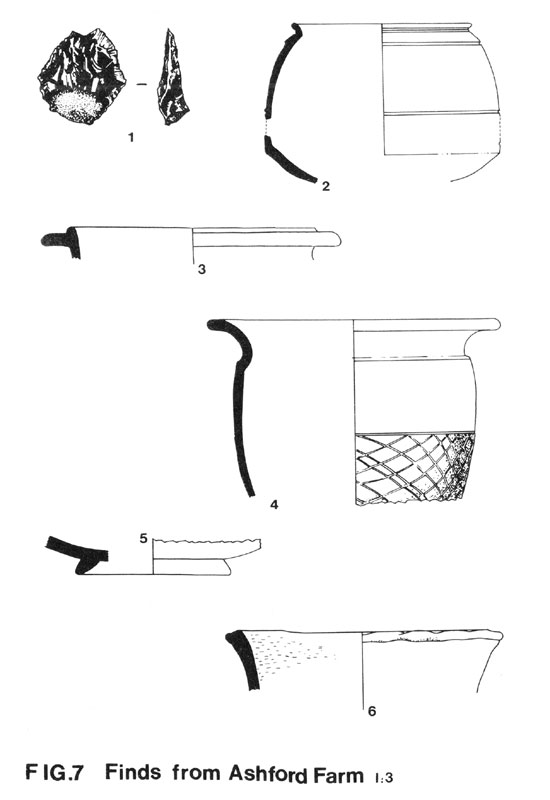
Finds are described individually below:-
- Scraper of fine brown flint, unpatinated. Made from a primary flake with some cortex remaining. Steep, 60° retouch. Probably prehistoric, late Neolithic or early Bronze Age.
Romano-British Pottery
- Carinated bowl with incised cordoned decoration; hand made in soft sandy grey fabric. Vessels of this ‘Belgic’ type in similar fine fabrics are dated to late 1st – 2nd centuries A.D. at Bush Marsh and Butcombe and No.85 at Westonzoyland is of similar fabric (H. Miles, 1969)
- Rim of dish with flange and high bead in black burnished quartz gritted fabric.Late 3rd/4th centuries by comparison with Camerton No.485 (W.Wedlake, 1958) and Gillam No.315 (Gillam 1968)
- Black burnished jar or cooking pot in quartz gritted fabric with wide everted rim and flat lattice decoration, scored under a horizontal line. Late 3rd/4th century. (Gillam 1968, No.148)
- Footring of colour coated bowl in soft red sandy fabric. The fragment does not allow of definite identification, but appears to be of Oxford manufacture. Probably 3rd-4th century. (Young 1977)
Medieval Pottery
A number of fragments were found, some with patchy green glaze.
- Rim of jar or cooking pot in a hard, sandy fabric with quartz and slat inclusions (Fig.7) up to 2mm in size. Hand made, grey with yellow brown ‘slip’ oxidised on outside. The sherd might have come from potteries at Nether Stowey in the 12th to 14th centuries. (H.E.J. Le Patourel, 1969)
Romano-British Sites in the Lower Parrett Valley
A distribution map (Fig.1) shows Romano-British sites found, to date, in the lower Parrett valley.
At Ashford, as at most other sites in the area, the greater part, up to 80% of pottery recovered dates from the late 3rd to 4th centuries (although it must be stressed that, at this site, even more than at others, because of the limited area of finds, only a very small fraction of the artefacts of the settlement must have been recovered). In all instances, however, occupation in the 1st/2nd centuries is evidenced by a smaller quantity of pottery, usually in ‘native’ styles. The much greater mass of 3rd/4th century pottery may point to a growing population and increasing size of settlement, but another cause may be found in greater prosperity, better communications and trade and the development of a commercial pottery industry.
From the distribution map, it can be seen that the sites, with the exception of the Cannington cemetery and hillfort, where special circumstances apply, are not found on the higher ground. They are either at approximately 50-80ft O.D. on a slight rise and near a stream, as at Ashford Spaxton and Bush Marsh, or on very low ground as at Combwich, Chilton Moor and Westonzoyland. It is of interest that these very low-lying sites occur both on the well-drained Burtle beds (Perry Court and Westonzoyland) and on the alluvial clay at Combwich and Chilton Moor.
Iron Age occupation is known on the higher ground at Broomfield, Ruborough, Dowsborough, etc. Is the lack of apparent Romano-British occupation at 150ft a fact, or has it not yet been found?
The few medieval sherds recovered from Ashford indicate medieval re-occupation at or near a Romano-British site. This is seen at other sites; Perry Court, Combwich, Bush Marsh, Westonzoyland. The question of the siting of settlements during the intervening Dark Age and Saxon periods is still largely unanswered.
REFERENCES
Gillam J.P. 1968 ‘Types of Roman Coarse Pottery Vessels in Northern Britain’ Oriel Press, Newcastle.
Le Patourel 1969 ‘Documentary Evidence and the Medieval Pottery Industry’ Mrs.H.E., Medieval Archaeology, Vol.12, p.104.
Miles H & T 1969 ‘Settlement Sites of the late Pre-roman Iron Age in the Somerset Levels’, Proc. Som. Arch. Soc.113, p36-7
Wedlake W.J 1958 ‘Excavations at Camerton, Somerset’ No.485, p.183
Young C.J 1977 ‘Oxfordshire Roman Pottery’, Brit. Arch. Reports 43, p164. FF.